Rooted In Resilience: Two Hungarian Farmers Navigate Adopting Regenerative Agriculture Practices
Across Hungary's agricultural landscape, two farms are navigating a shared reality: farming at a time of increasing uncertainty. From shifting weather patterns to volatile markets, growers are being pushed to rethink how they manage their land, protect the soil and sustain their operations for the future. While these two operations differ, their experiences reveal striking similarities. Both farms are rooted in traditional crop production systems and are now exploring new approaches designed to improve soil health, reduce inputs and build resilience with the support of ADM, through its re:generations™ program operated in Hungary by Bayer Ecosystem Services.
ADM's re:generations™ program bridges the gap between environmental stewardship and farm profitability by providing growers with direct financial incentives and expert technical support. By adopting best practices like cover cropping and reduced tillage, participants enhance soil health and climate resilience while utilizing program data to sequester emissions.
For Tibor Pokoraczki of Agro-Cserkesz Kft. in northeastern Hungary and Zoltán Németh of Hahóti Várdomb Kft. in the northwest, the shift represents both a practical response to modern challenges and a vital long-term strategy. The re:generations™ program equips farmers with the tools necessary to future-proof their operations and strengthen development for the next generation.
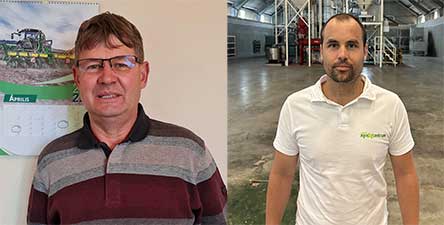
Farming at scale, grounded in tradition
Pokoraczki manages approximately 900 hectares and includes a rotation of staple crops such as maize, sunflower, winter oilseed rape and winter wheat. Over time, he has introduced additional crops such as sweet corn and winter poppy, gradually expanding the diversity of his rotation. Alongside crop production, the farm also provides machinery services within the region.
Németh's operation is larger, spanning approximately 2,500 hectares across a group of companies. The crop rotation of the company group includes maize, soybean, cereals, oilseed rape and fodder peas. What sets his operation apart is its vertical integration where the farm operates its own seed production facility, which enables the group to produce seeds for several crops, including wheat, barley, soybeans and fodder peas.
Despite these differences, both farms are deeply rooted in Hungary’s agricultural traditions – systems that have long relied on conventional tillage and relatively stable seasonal patterns. However, those conditions are changing.
Managing uncertainty is a shared challenge
For both farmers, the most pressing challenge is the weather.
Pokoraczki describes a growing imbalance of less precipitation overall combined with increasingly erratic distribution. Without consistent moisture, crops struggle to establish, and even well-planned practices, such as cover cropping, can fail before they begin.
"The biggest challenge is the weather and the lack and unpredictability of precipitation," said Pokoraczki. "Farming on predominantly sandy, hilly soils, our land is particularly vulnerable to drought conditions and uneven rainfall distribution."
Németh faces a similar issue, even in a region that traditionally receives more rainfall. "The distribution of precipitation is often extremely bad, which poses serious challenges in everyday work," said Németh. "The effects are strongly felt, and this is why we are looking for alternative crops with which we can adapt to these changes."
For example, this year Németh explained that the farm will include chickpeas in the crop rotation to offset the effects of the unpredictable weather conditions.
Both farmers also point to broader economic pressures. Fluctuating input costs, particularly for fertilizers, and volatile crop prices have added layers of financial uncertainty. External factors, such as the influx of imported grain into Hungarian markets, further complicate an already challenging environment. Together, these combined pressures are pushing farmers to reconsider not only what they grow, but how they grow it.
A shift to regenerative practices
For both farmers, the move toward regenerative agriculture did not happen overnight. Instead, it emerged gradually, shaped by years of observation, experimentation and a growing awareness of soil degradation. Participation in the re:generations™ program has aligned with changes they were already making, reinforcing their path toward adopting regenerative agriculture practices.
Pokoraczki recalls hearing for years at industry forums that conventional large-scale farming systems and crop production were not sustainable in the long term and were placing increasing strain on soils. He explains that the opportunity to join ADM's re:generations™ program came at the right time, providing the chance to look at his own fields and determine how regenerative practices may fit his operation.
"We dug soil profiles and tried to draw conclusions," said Pokoraczki. "We then put those conclusions into practice to ensure that future generations have the opportunity for effective and sustainable farming."
These insights led to early testing of regenerative practices like reduced tillage, which eventually culminated in the farm no longer supporting ploughing practices on the field. Today, the farm also operates no-till trial areas, allowing the team to evaluate how crops perform under even lower levels of disturbance. Pokoraczki also explains that recent technological advancements made on the farm closely aligned with the goals and resources the re:generations™ program provides, such as soil cultivation, which uses data to help sequester emissions but also equips agricultural businesses with the modern tools necessary to future-proof their operations and strengthen long-term development.
Németh's path followed a similar trajectory. Facing rising uncertainty, his focus turned to reducing inputs, limiting field operations and minimizing environmental exposure. The re:generations™ program offered a way to align these goals.
"Our goal was to reduce the number of operations and inputs and the exposure to environmental impacts," said Németh. "We sow cover crops directly, which allowed us to eliminate stubble cultivation across 1,400 hectares. Some main crops are also planted using direct seeding methods. The results are already tangible: diesel consumption has been reduced by 15%, a significant efficiency gain for an operation of this scale."
Learning by trial and error
Transitioning to regenerative agriculture is not without its challenges, and both farmers are candid about the learning curve.
Pokoraczki notes that his experience with cover crops has been mixed. In theory, they play a critical role in protecting soil and building organic matter. In practice, however, dry conditions often prevent successful establishment. Delayed planting windows mean cover crops may only remain in the field for a short period, limiting their effectiveness.
Similarly, his no-till trials have yet to match the yields of conventional systems. But he sees encouraging signs elsewhere. Soil condition, measured regularly using a penetrometer, has improved noticeably in less-disturbed fields. The measurements also prove that the less disturbed areas are in better condition at a given time compared to a traditionally cultivated field because it is much easier to press the penetrometer on a no-till field.
Németh has observed comparable trade-offs. While yield impacts are still being evaluated, improvements in soil structure and water retention are already evident. Fields managed with regenerative practices absorb water more effectively and retain it longer, leading to visibly healthier crops. Improved soil structure is also becoming more apparent over time.
"The less disturbed soil absorbs water much better and holds it longer," he said. "In side-by-side comparisons, the difference between regenerative and conventional fields is clear."
Building a resilient future
Both farmers see regenerative agriculture as an essential part of the future of farming in Hungary.
Pokoraczki believes acceptance will continue to grow as more farmers observe and learn from early adopters. "Farmers in the area are following the practices," he noted, suggesting that practical examples can play a powerful role in driving change.
"We want to maintain our effectiveness, but sustainability is also a key issue. That is why we do our best to adapt regenerative practices to local conditions as much as possible," said Pokoraczki. "We have always been open to new solutions and are gradually incorporating practices that work locally into our operations."
Meanwhile, Németh has set specific targets. Within five years, he aims to grow more than half of his crops under no-till conditions. Achieving this would not only reduce operational costs but also lower fuel consumption by an estimated additional 20%. Németh agrees interest in adoption will continue to grow among farmers in the area but emphasizes that broader support will be needed to accelerate adoption. He explains that ADM's re:generations™ is a good example of how programs can support farmers because it provides valuable incentives and strategic guidance as farmers transition and adopt regenerative practices, and it could offer a framework for how policy and subsidy frameworks need to evolve to encourage wider participation.
At the same time, both farmers recognize that the transition is not purely technical; it is also cultural. Changing long-established practices requires a shift in mindset, and for many farmers, that may be the most difficult step.
The experiences of these two Hungarian farmers reflect a broader shift taking place across agriculture. They are rethinking how they manage their land – not just to maintain productivity today, but to ensure its viability for years to come.
Regenerative agriculture, in this context, is not a single solution but a framework for continuous improvement. It requires patience, flexibility and a long-term perspective – qualities that both Pokoraczki and Németh demonstrate as they adapt their operations. As environmental and economic uncertainties arise, their efforts underscore a simple but powerful idea: resilience begins in the soil.