Advancing Salmonid Performance with Next-Generation Early Nutrition
The hatchery and nursery stages are the most critical phases in the production of salmonids, a family of ray-finned fish species that includes salmon, trout and char. During this early life stage, fish undergo rapid physiological development, including maturation of the digestive and immune systems and musculoskeletal development. Early nutrition also helps establish the foundation for long-term growth, feed efficiency, performance and health.
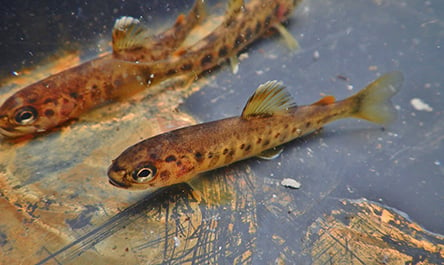
To help producers meet these needs, ADM has developed NURSal, a specialized nursery feed for salmonids that combines advanced manufacturing technology with a nutrient-dense formulation designed to support digestibility, palatability, nutrient retention and uniform feeding during early development. NURSal is the latest example of ADM's focus on advanced nutrition, applying specialized formulation science and advanced manufacturing to deliver high-performance, functional products. By supporting digestibility, nutrient retention, and early gut resilience, NURSal helps producers translate advanced nutritional science into measurable production outcomes.
Young salmonids have an incompletely developed digestive system and limited enzymatic capacity, making highly digestible nutrition particularly important. NURSal is designed to deliver high-quality nutrients while protecting nutritional integrity. It is manufactured using cold micro-extrusion followed by marumerization, and precision sieving.
During cold micro-extrusion, feed is processed at temperatures below 70°C to help minimize protein denaturation and preserve heat-sensitive nutrients, while marumerization produces highly spherical pellets with a smooth, sealed surface that supports water stability and reduces nutrient leaching. Precision sieving further ensures consistent particle size, which is an important consideration for fast-growing salmonids, where uniform feed intake can contribute to more consistent growth across the population.
NURSal is formulated with high-quality marine proteins and fats and provides 52-55% protein, along with essential fatty acids, including omega-3 highly unsaturated fatty acids (HUFA), DHA and EPA. The combination of nutrient density, digestibility, attractability and physical pellet quality supports efficient nutritional intake during the critical early feeding period.
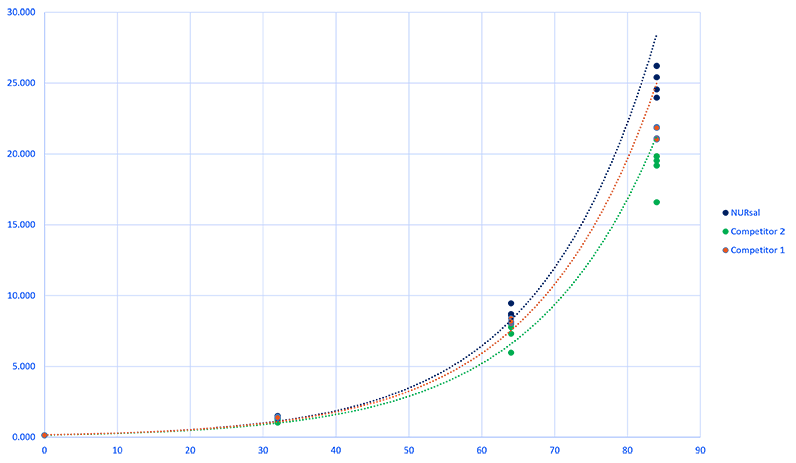
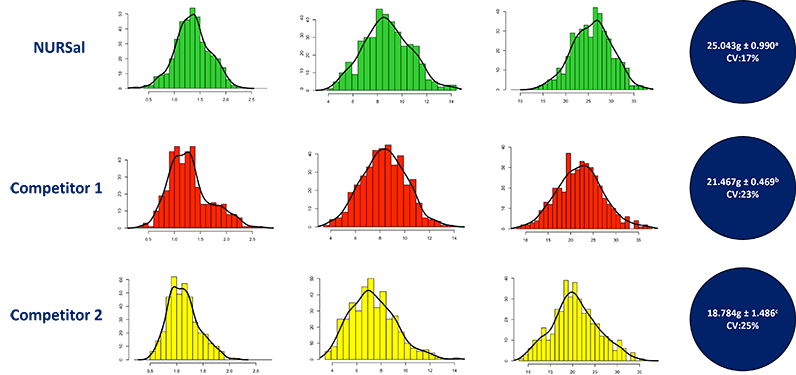
ADM's research demonstrates the performance potential of NURSal. During a 90-day feeding trial in France, triploid rainbow trout were fed NURSal or one of two commercially available starter feeds. After 84 days, fish receiving NURSal reached an average body weight of 25.0 grams, compared with 21.4 grams for the micro-extruded competitor and 18.7 grams for the crumble feed – representing 17% and 33% higher final weights, respectively. Fish fed NURSal also reached the 25.0-gram target approximately seven days earlier, while maintaining a feed conversion ratio of 0.66.
The trial also demonstrated improved population uniformity. Fish fed NURSal had a coefficient variation of 17%, compared with 23% and 25% for the two competing diets, with the differences statistically significant. Greater size uniformity can help simplify grading and reduce size-related competition within the population.
These results highlight how targeted early nutrition and advanced feed technology can help salmonid producers support growth, uniformity and efficient production, helping fish reach their genetic growth potential from the very beginning of the production cycle. Saving 7 days to reach 25 g translates into approximately 31 days saved over the course of a year, which is particularly valuable for high-intensity, high-CAPEX aquaculture systems such as Recirculating Aquaculture Systems (RAS).
Additionally, as part of the trial, the gut microbiome of the fish was also evaluated. Samples from 20 fish per treatment were analyzed by Kytos BV using flow cytometry. The results showed differences in microbiome composition and activity between dietary treatments. NURSal showed characteristics associated with a more resilient microbial community. Results showed the Overall Health Score and alpha diversity were significantly higher in the NURSal group. NURSal also showed a significant reduction in bacterial populations. These findings indicate the NURSal® diet supporting a gut microbial environment with favorable characteristics during the early developmental stages.
One possible contributor to these results is ADM's functional feed LifeDefense® concept, which is incorporated into NURSal and designed to support animal health and performance at different stages of production. In early nutrition, the concept focuses on maintaining a favorable intestinal environment by helping control undesirable bacterial populations while supporting beneficial or commensal bacteria. LifeDefense® and NURSal consist of a combination of two proprietary feed additives and dedicated premix.
By combining advanced nutrition with specialized feed technology, NURSal is designed to help producers make the most of one of the most formative stages in salmonid production. Because early nutrition can influence growth, health, feed efficiency and performance throughout the production cycle, providing the right nutrition from first feeding is an important investment in long-term results.
NURSal also reflects ADM's broader commitment to helping aquaculture producers address their evolving nutritional needs through science-backed solutions. With expertise spanning nutrition, formulation and feed technology, ADM works to understand the challenges producers face and translate that knowledge into practical solutions. For salmonid producers, NURSal offers more than a specialized nursery feed – it is part of ADM's approach to partnering with customers to support performance from the earliest stages and throughout the production cycle.
Disclaimer: Not all products are available in all regions. ADM makes no representation or warranty, whether expressed or implied, as to the reliability, or completeness of the information. The uses and claims should be adapted to comply with the current local/regional regulatory environment. This information does not imply any express recommendations for the cure, mitigation, treatment or prevention of disease.