Rooted in Resilience: A German Farmer's Regenerative Journey
Across Europe, farmers are finding new ways to strengthen the long‑term health of their land and the resilience of their businesses amid challenges like unpredictable weather, rising costs, and market volatility. Regenerative agriculture offers a positive path forward - helping farms remain productive and profitable by prioritizing soil health, reducing soil disturbance, and diversifying crop systems.
At LBG GbR Bagemuehl in Woddow, Wilhelm Zahn and his team manage around 700 hectares of arable land in Brandenburg's Uckermark region. They are demonstrating how regenerative principles can translate into action. Having already introduced soil conservation practices, Zahn found that ADM's re:generations™ program complemented his existing approach - providing additional support, data, and financial incentives to help the farm take its regenerative efforts further.
"We committed ourselves to soil conservation practices," he explains. "That meant trying to avoid full‑area soil disturbance wherever possible."
With ADM re:generations™, they found both technical support and financial incentives to accelerate their transition. The program helps farmers adopt regenerative practices such as cover cropping and reduced tillage - improving soil health, biodiversity, and water retention while strengthening farm resilience.
The farm introduced a Strip‑Till One Pass system, disturbing only narrow strips of soil where seeds are placed. Half the land now remains untouched at the surface, preserving soil structure and biological activity. But for Zahn, regenerative agriculture is about more than just machinery.
"Regenerative practices have to be implemented across the entire crop rotation and across all crops," Zahn said. "If you only use the technology occasionally, you don't get the same positive effect."
This mindset led the farm to diversify its crop rotation beyond the traditional wheat, barley, and oilseed rape. Catch crops now protect the soil surface and boost organic matter, while new crops - including oats, maize, hemp, and soybeans - help strengthen the overall system.
"We sometimes accept that certain crops are not the most lucrative," he explains. "But the important question is whether the overall system works. If a crop helps the rotation function better and improves the soil, then it can still be worthwhile."
Beyond crop choices, the farm also deepened its understanding of soil health through more detailed analyses - including tests for micronutrients and biological indicators. The team experimented with compost tea and alternative fertilization strategies aimed at strengthening biodiversity and supporting microbial life in the soil.
Dry seasons in 2018 and 2019 reinforced the importance of these changes. Reduced soil disturbance helped the farm's soils retain moisture and absorb rainfall more effectively.
"Soil simply needs time to recover," he explains. "But every year we see progress. In some areas water infiltration is now much better than it used to be."
The results are tangible. Improved biological activity has accelerated the decomposition of straw mulch, nutrient cycles have stabilized, and nitrogen leaching has dropped. The farm even began experimenting with undersown crops in oilseed rape - planting legumes and companion crops to suppress weeds and improve nitrogen dynamics.
"In a dry summer you are never completely sure whether the cover crop will grow," he says. "So even a small payment per hectare can make it easier to plant more hectares with confidence."
Looking ahead, Zahn believes regenerative agriculture will continue to grow across Germany as more farmers gain experience and see the benefits firsthand.
"In practice it's often a gradual process," he says. "But the more farmers gain experience with it, the more widely it will spread."
And his advice for others considering ADM's re:generations™ program is simple: "I would definitely recommend ADM and re:generations™. It's a good incentive to integrate practices like cover crops or reduced tillage, as well as implement them on as much land as possible."
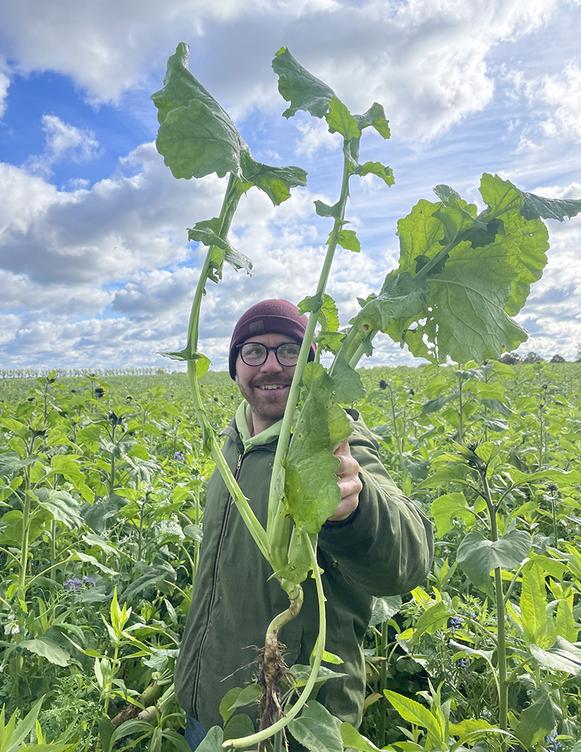
Ultimately, Zahn's goal is to build a system that can withstand both environmental and economic pressures - proving that healthy soil truly is the foundation for resilience.
"Healthy soil is the foundation - and the work to build resilience continues with every season."